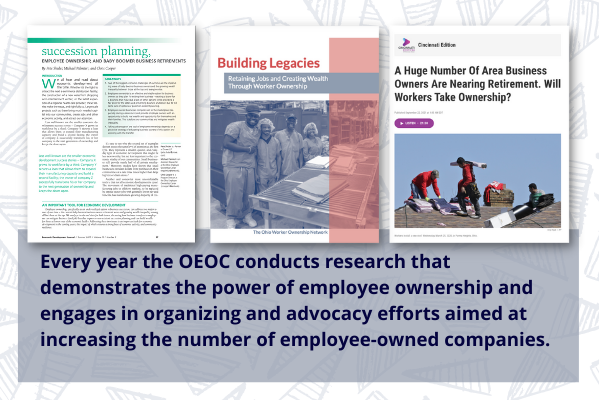
Employee ownership is a proven strategy that:
Creates a viable, potentially tax-advantaged ownership succession strategy for small businesses – Employee ownership can provide a fair price for the business, may offer significant tax benefits for both the seller and the business, and will help preserve the business' legacy for generations.
Retains businesses, preserves jobs, and anchors wealth –
Employee-owned businesses are less likely to relocate, shut down, or lay off workers, particularly during economic downturns.
Improves company performance –
Studies have consistently shown that employee-owned firms, on average, outperform comparable companies: higher profitability and productivity, higher retention rates, and more resilience during economic downturns.
Improves employee outcomes – Employee-owned companies, on average, pay higher wages, provide more (and better) benefits, and create opportunities to build real wealth.
Today, Ohio is home to 362 employee-owned companies employing an estimated 716,060 workers, who together hold $110.5 billion in company assets.
In Ohio, the two primary forms of worker ownership include Employee Stock Ownership Plans (ESOPs), of which there are 335, employing 715,619 workers, and 27 worker cooperatives, with 441 workers. Ohio is home to some of the nation’s largest ESOP and worker cooperative companies. Davey Tree, an ESOP company based in Kent, is the 9th-largest privately held 100% ESOP company in the US, with 12,156 workers. Likewise, Evergreen Cooperative Laundry, based in Cleveland, ranks among the country's top 5 largest worker cooperatives with an estimated 200 workers.
There is no single employee ownership model. Instead, there are a variety of models that give workers a meaningful stake in their company's success. While these models differ in governance, financing, and implementation, they all aim to create shared value and support long-term business continuity. The sections below highlight four widely used approaches in the U.S.
ESOPs are the most common form of broad-based employee ownership in the US. Currently, there are roughly 6,500 companies in the US with an ESOP; nearly 14 million American workers participate in them; and they own more than $1.8 trillion in assets. ESOPs can be found in both private and public companies, and in every major sector of the economy.
How it Works: An ESOP is a qualified retirement plan, similar (yet different) to a 401(k), that invests in the stock of the sponsoring company, which is placed in an ESOP trust. Eligibility requirements are set, and once a worker meets those requirements, they become a participant in the ESOP. Every year, the company makes a tax-deductible contribution to the ESOP, which is then allocated to participating employees' individual accounts, using a formula. Unlike a 401(k), employees do not contribute to the ESOP; it is typically 100% company-funded. When employees leave or retire from the company, they begin to receive their ESOP benefit.
Worker cooperatives are the second-largest segment of employee-owned businesses in the US, with an estimated 1,000 cooperatives employing 10,000 workers. Even though the number of US worker cooperatives is relatively small, it is the most common form of employee ownership worldwide.
How it works: A worker cooperative is owned by the worker-members who are 1) employed by the company, and 2) become members of the cooperative by paying the membership fee. Once a member, workers have the opportunity to participate in the running of the business (including serving on and voting for the Board of Directors) and to receive a share of company profits every year (called patronage or patronage refund). Employees can also build value in an internal capital account, where a portion of the patronage can be placed, which is paid to them when they leave the company or retire.
Employee Ownership Trusts are a growing form of broad-based employee ownership in the United States, modeled after a widely used structure in the United Kingdom. Although fewer than 100 EOTs currently operate in the U.S., interest is increasing—particularly among owners seeking a straightforward, mission-aligned succession option that preserves company continuity.
How it works: EOTs are owned by a trust established by the selling owner, with the requirement that the company operates for the benefit of the employees. A commonality among EOTs is that most have language in the trust document stating that most or all profits (above those needed for reinvestment in the business) go to the employees. Employees are beneficiaries of the trust while employed, allowing them to receive financial benefits, but have no ownership or equity in the company. For that reason, EOTs are thought of more as a profit-sharing model than an equity model.
Direct share ownership is a flexible model in which employees hold company stock directly in their own name. While less common than ESOPs or worker cooperatives, it is used by a range of closely held firms that want a simple, transparent way to share equity broadly with employees.
How it works: Employees become owners by receiving or purchasing shares from the company. These shares can provide voting rights, dividends, or other financial benefits, depending on company policies. Because shares are held individually, companies typically establish clear rules for how shares are bought, sold, or repurchased—especially when an employee leaves the business. Over time, employees can build equity as the company grows, allowing them to share directly in the value they help create without the use of a trust or cooperative structure.
.png)
.png)


.png)
.png)


.png)

%20.png)

.jpeg)
.png)
.jpeg)
-Slider%20300x200.png)