Click the links below to order printed copies.
First Class Mail delivery to domestic US address is included in price of book. If outside the continental U.S., contact the OEOC for shipping information. Tax (applicable to all Ohio orders): 7.25%
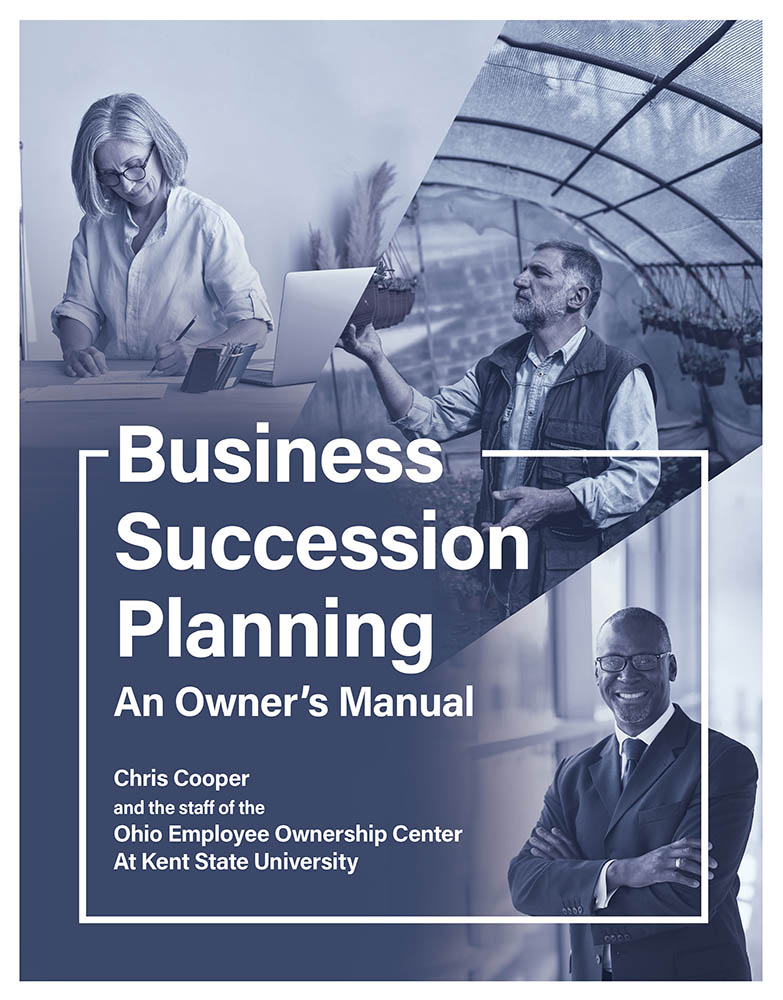
With support from The Cleveland Foundation, we have published a new book on business succession planning Business Succession Planning: An Owners Manual. The book provides business owners with basic information and worksheets that enable the development of an initial business succession plan. It is designed following a 5-step process that includes:
1. Defining goals and objectives, for your business and yourself (and family)
2. Determining how much your company is worth
3. Exploring available options for selling or transferring your business
4. Developing and implementing your succession plan
5. Developing a personal plan for the next stage of your life
John Logue, Bill McIntyre, the staff of the Ohio Employee Ownership Center and the Cooperative Development Center at Kent State University have published this book with support from The Cleveland Foundation.
If you are a business owner looking for an exit strategy that can provide you with:
then one of the employee ownership models may be the right fit for you.
This manual describes the common employee ownership strategies in non-technical, easy to understand language, and will help you to explore which option is right for you.
Hardcopies can be purchased through this link.
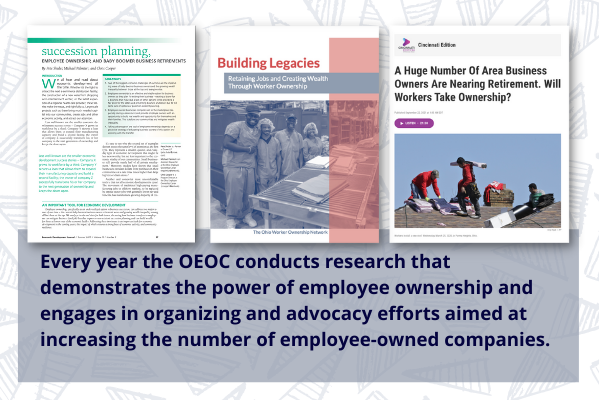
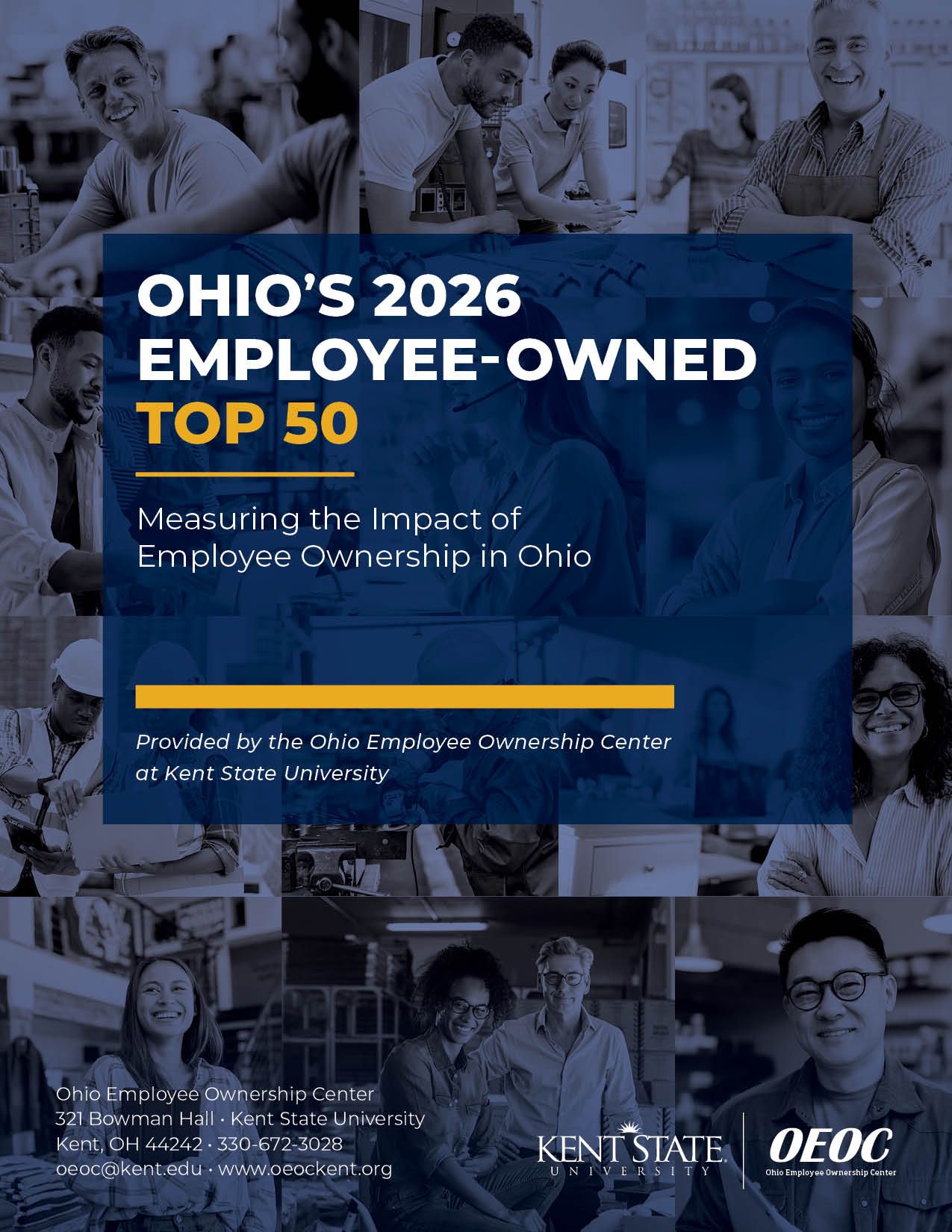
For over 20 years the OEOC has published the Ohio Top 50 report which provides an overview of ESOP companies in Ohio as well as rankings for the largest ESOPs by assets, number of participants, and value per participant. The report also provides the total number of ESOPs in Ohio along with a sectoral breakdown.
Top 50 - 2025 Report
Top 50 - 2024 Report
Top 50 - 2023 Report
Top 50 - 2020 Report
Data for Ohio’s 2025 Top 50 was drawn from several sources: publicly available IRS Form 5500 reports, downloaded from the IRS website, as well as data compiled by 1) the National Center for Employee Ownership; 2) an ongoing OEOC survey of Ohio companies conducted every year; 3) phone calls, and 4) press and news reports. The lists presented here are based off Form 5500 filings.
This report is the first quarterly report of 2024 published by the Shares Laboratory at the Rutgers Institute for the Study of Employee Ownership and Profit Sharing and co-authored by Michael Palmieri of the OEOC. Using data from the General Social Survey spanning 20 years (2002-2022), this report graphically communicates broad findings about he quality of jobs held by employees who participate in employee share ownership. There are four sections in this report, each demonstrating the individual benefits of employee share ownership:
Established in 2023, The Shares Laboratory is the nation’s first academic research initiative dedicated to employee equity compensation and employee equity ownership in corporations.
In collaboration with Prairie Capital Advisors, we have published a report ESOPs in the Grocery Industry. The COVID-19 pandemic and ongoing market concentration within the grocery industry has placed challenges on the large number of companies that still operate independently. This report outlines how owners of grocery stores have more options than simply selling to a larger firm. It provides an overview of how business owners can sell their company to employees using an Employee Stock Ownership Plans (ESOPs), allowing them to get a fair market price, maintain their legacy, and remain independent.
In addition to an overview of national trends in the industry the report also focuses on the grocery industry in Ohio and provides case studies of companies that have successfully transitioned to employee ownership using an ESOP.
If you are interesting in learning more about employee ownership in the grocery industry please email oeoc@kent.edu.
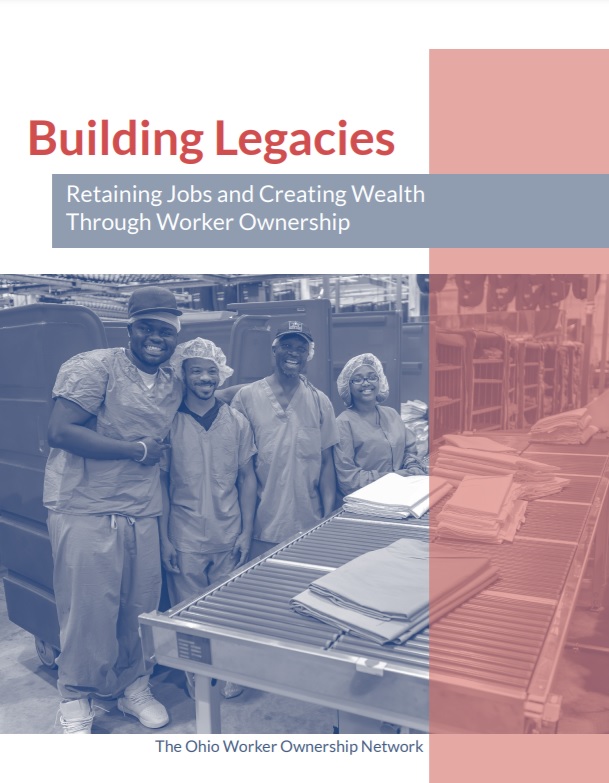
Building Legacies is a report that outlines how decades of research and experience demonstrate that worker ownership is a proven economic development strategy that can retain and strengthen businesses, create dignified family-sustaining jobs, and provide real wealth-building opportunities for individuals and communities. There are clear benefits that worker ownership offers:
The report highlights how worker ownership can be used as a way to lower economic inequality, remedy precarious work conditions, and provide baby-boomer business owners with a succession planning option that leaves their legacy intact. Building Legacies also provides case studies and examples of successful transitions to employee ownership along with detailed policy recommendations and contact details for support organizations currently working to increase the number of employee-owned companies in Ohio.
Authored by Margaret Lund for publication by of the Cooperative Development Center at Kent State University.
Multi-stakeholder cooperatives (MSCs) are co-ops that formally allow for governance by representatives of two or more “stakeholder” groups within the same organization, including consumers, producers, workers, volunteers or general community supporters. Rather than being organized around a single class of members the way that most cooperatives are, multi-stakeholder cooperatives enjoy a heterogeneous membership base.
The common mission that is the central organizing principle of a multi-stakeholder cooperative is also often more broad than the kind of mission statement needed to capture the interests of only a single stakeholder group, and will generally reflect the interdependence of interests of the multiple partners.
This manual explains the multi-stakeholder cooperative model, provides examples through case studies, and more.
In 2018, the Kendeda Fund launched a series of Big-Bet grantmaking opportunities – one-time focused investments in timely and critical issues, to help propel work to new levels of capacity and reach. One of those Big Bets focused on Employee Ownership with four major goals in mind.
With these goals in mind, the Kendeda Fund granted over $24 million to four organizations that were exploring ways to transition small and medium sized companies to employee ownership. The grantee organizations included The Evergreen Cooperatives Fund for Employee Ownership, ICA Group, Nexus Community Partners, and Project Equity.
.png)
.png)

.png)
.png)

.png)
%20.png)
.jpeg)
.png)
.jpeg)
-Slider%20300x200.png)



.png)